Learn how the ALCOA+ principles help pharmaceutical companies maintain accurate, reliable, and trustworthy data. Discover the importance of data integrity, GMP compliance, electronic records, documentation practices, and the role of ALCOA+ in pharmaceutical manufacturing and quality assurance.
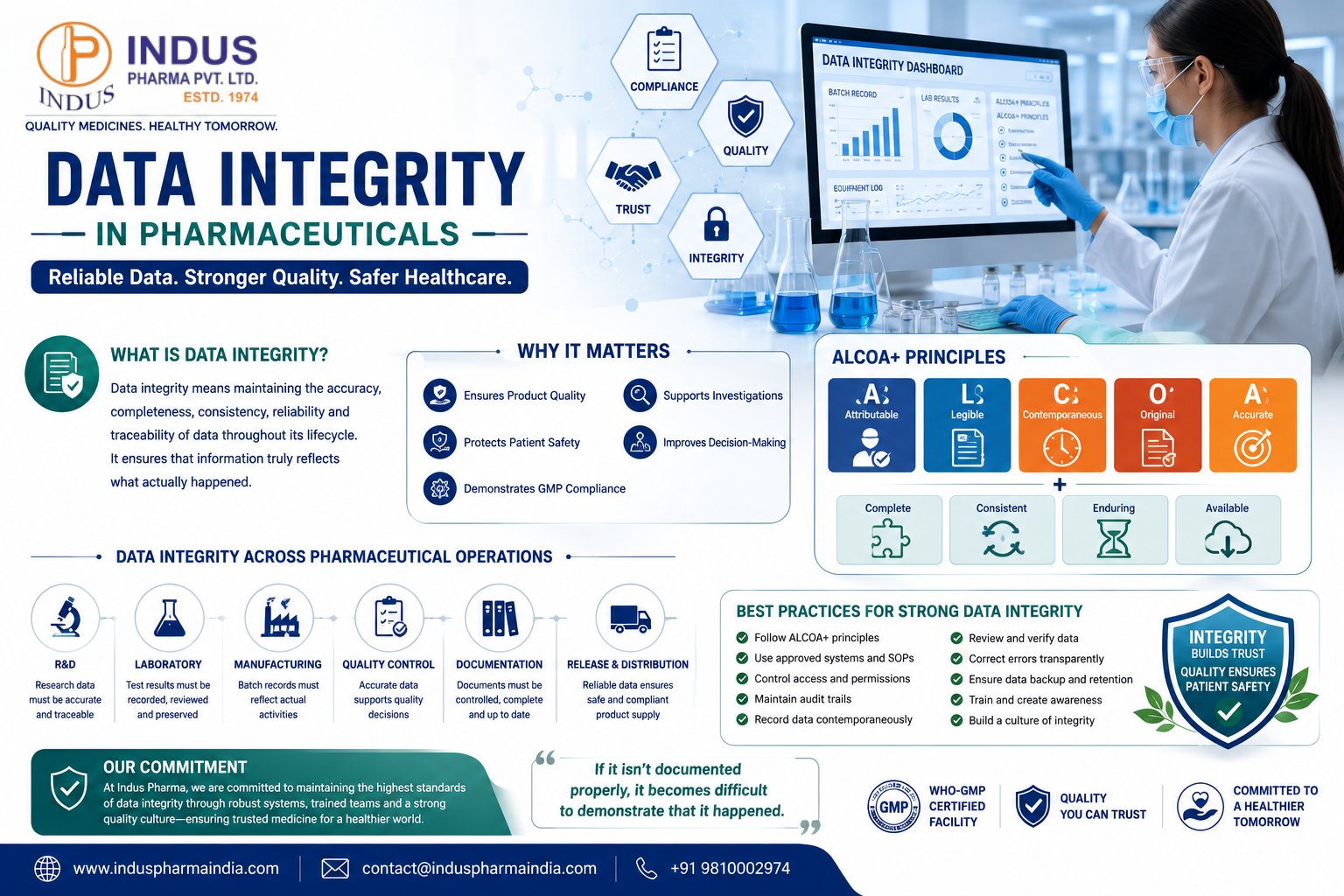
In the pharmaceutical industry, data integrity is fundamental to product quality, patient safety, and regulatory compliance. Every record—from manufacturing and laboratory testing to quality control, documentation, and distribution—must be reliable and traceable.
This is where the ALCOA+ principles play a critical role.
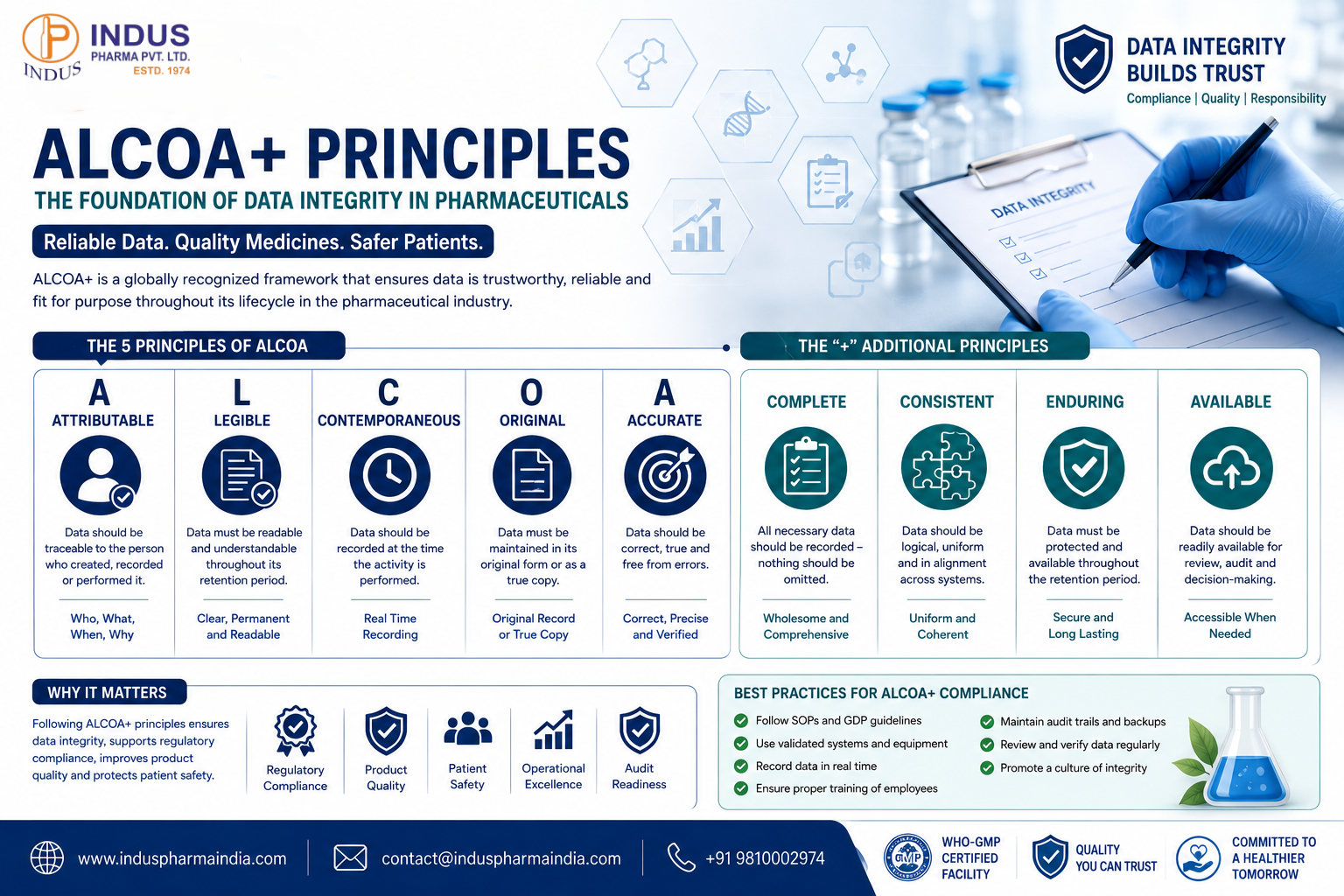
ALCOA+ provides a framework for ensuring that pharmaceutical data remains trustworthy throughout its entire lifecycle. It is particularly important for companies operating under Good Manufacturing Practices (GMP) and other regulatory quality systems.
For pharmaceutical manufacturers and exporters, following ALCOA+ principles helps establish confidence that records accurately represent the activities that actually occurred.
What Are ALCOA+ Principles?
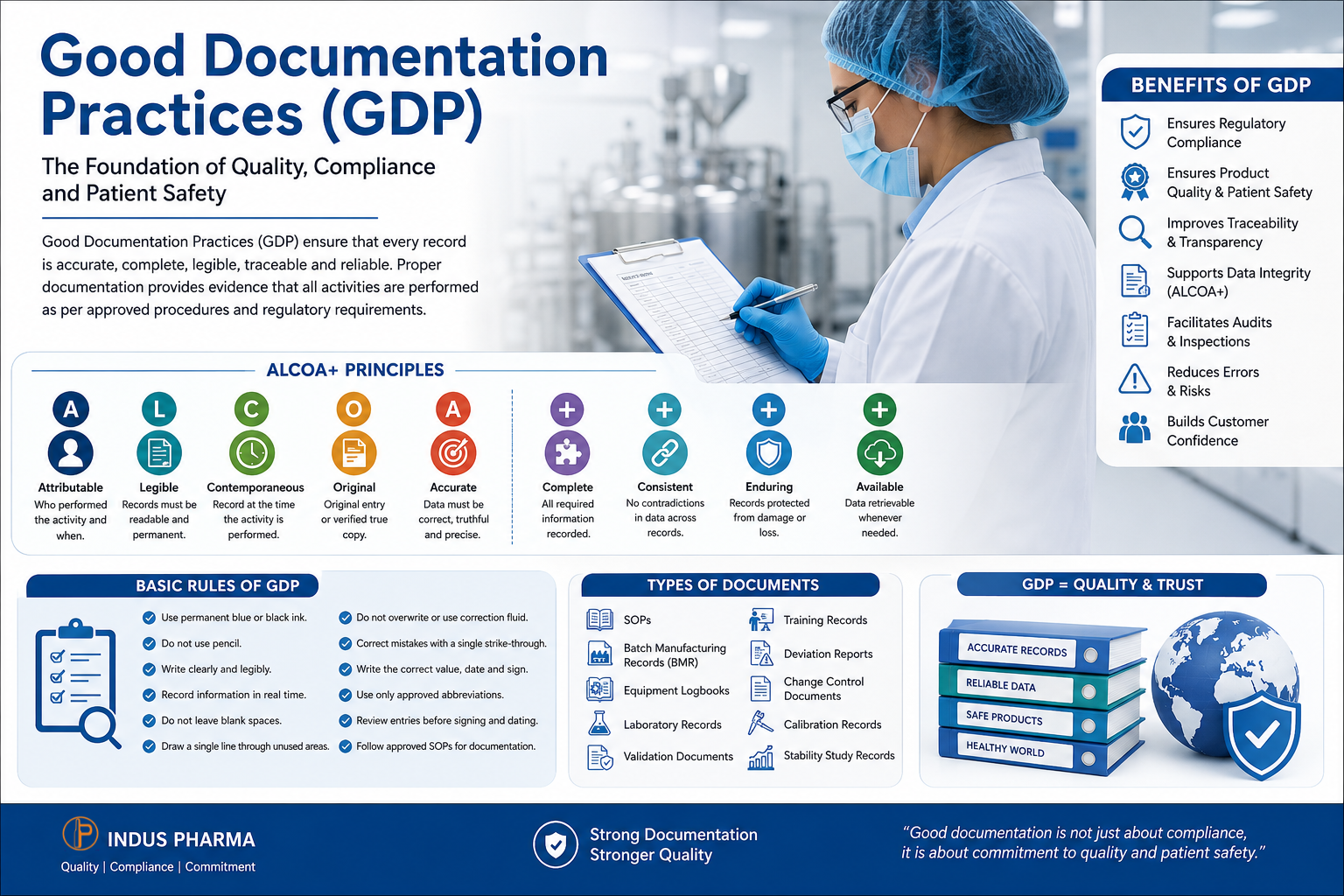
ALCOA is an acronym representing five fundamental characteristics of reliable data:
- A — Attributable
- L — Legible
- C — Contemporaneous
- O — Original
- A — Accurate
The "+" expands the framework with additional expectations:
- Complete
- Consistent
- Enduring
- Available
Together, these principles provide a comprehensive approach to pharmaceutical data integrity and Good Documentation Practices (GDP).
1. A — Attributable
Data must be traceable to the person or system that generated, recorded, or modified it.
A pharmaceutical record should make it possible to determine:
- Who performed the activity?
- Who recorded the information?
- When was it performed?
- Who reviewed or approved it?
For example, a laboratory analyst performing an HPLC test should record the activity using an identifiable user account or appropriate signature.
Why it matters
Attributable data creates accountability and helps organizations investigate deviations, errors, and unexpected results.
SEO Keywords:
Attributable Data, Pharmaceutical Data Integrity, GMP Data Integrity
2. L — Legible
Records must be readable and understandable throughout their retention period.
Whether data is maintained electronically or on paper, it should remain clear and accessible.
Examples include:
- Clearly completed batch records
- Readable laboratory notebooks
- Properly maintained logbooks
- Clear electronic records
- Legible signatures and entries
Corrections must also be performed according to approved procedures without obscuring the original information.
Why it matters
Unreadable or unclear records can make it impossible to verify what actually happened during manufacturing or testing.
3. C — Contemporaneous
Data should be recorded at the time the activity is performed.
Employees should not rely on memory or record information later without appropriate justification.
For example, if an operator performs a manufacturing activity at 10:00 AM, the corresponding record should be completed at the appropriate time rather than several hours later.
Why it matters
Contemporaneous documentation provides an accurate chronological history of manufacturing and quality activities.
This principle is closely associated with Good Documentation Practices (GDP).
4. O — Original
Data should be maintained in its original form or as a verified true copy.
Original records can include:
- Laboratory raw data
- Original test results
- Electronic records
- Equipment-generated data
- Original batch manufacturing records
- Instrument printouts
When electronic systems are used, appropriate controls should ensure that original data remains secure and traceable.
Why it matters
Original records provide evidence of the actual activity, measurement, observation, or result.
5. A — Accurate
Data must be correct, truthful, and free from intentional or uncontrolled errors.
Accuracy can be supported through:
- Properly calibrated instruments
- Validated software systems
- Qualified personnel
- Appropriate review processes
- Second-person verification where required
- Controlled data entry
If an error occurs, it should be corrected according to approved procedures while maintaining the original information and documenting the reason for the correction when required.
The "+" in ALCOA+
The additional four principles strengthen the original ALCOA framework.
Complete
Data should include all relevant information—not just selected or favorable results.
For example, laboratory records should retain relevant raw data, including appropriate information regarding repeated or invalidated analyses according to applicable procedures.
Complete data supports reliable investigations and informed quality decisions.
Consistent
Records should follow a logical and consistent format throughout their lifecycle.
This includes:
- Chronological recording
- Consistent date and time formats
- Consistent terminology
- Proper version control
- Consistent documentation practices
Consistency makes records easier to review, investigate, and audit.
Enduring
Data must remain preserved and readable throughout the required retention period.
Pharmaceutical organizations should protect records against:
- Accidental deletion
- Physical damage
- Unauthorized modification
- Data corruption
- Loss of electronic systems
Appropriate backup, archival, access-control, and retention procedures are essential.
Available
Data must be readily accessible to authorized personnel whenever required.
Records may be needed for:
- Batch release
- Quality investigations
- Internal audits
- Regulatory inspections
- Product recalls
- Deviation investigations
- CAPA activities
Availability does not mean unrestricted access. Data should remain accessible to authorized users under appropriate security controls.
Why ALCOA+ Is Important in Pharmaceutical Manufacturing
Pharmaceutical companies generate enormous amounts of data every day.
Examples include:
- Batch manufacturing records
- Laboratory test results
- HPLC data
- Environmental monitoring records
- Equipment logs
- Cleaning records
- Temperature monitoring
- Stability data
- Training records
- Deviation reports
- CAPA documentation
- Electronic batch records
If this data is incomplete, inaccurate, or unreliable, it can compromise product quality and patient safety.
ALCOA+ helps organizations build a strong data integrity culture where employees understand that accurate documentation is an essential part of pharmaceutical quality.
ALCOA+ and Good Documentation Practices (GDP)
Good Documentation Practices (GDP) and ALCOA+ principles are closely connected.
Employees should follow practices such as:
- Record information promptly
- Use permanent and appropriate entries
- Never falsify records
- Avoid backdating
- Correct errors transparently
- Maintain traceability
- Use approved forms and systems
- Protect records from unauthorized changes
Proper documentation provides evidence that manufacturing and quality processes were performed according to approved procedures.
ALCOA+ in Electronic Data Systems
Modern pharmaceutical companies increasingly depend on electronic systems for manufacturing, laboratory, training, quality, and business processes.
Examples include:
- Laboratory Information Management Systems (LIMS)
- Electronic Batch Records (EBR)
- Document Management Systems (DMS)
- Enterprise Resource Planning (ERP)
- Training Management Systems (TMS)
- HPLC and analytical software
- Environmental monitoring systems
Electronic systems should provide appropriate controls such as:
- Unique user accounts
- Role-based access
- Audit trails
- Secure authentication
- Data backup
- Controlled system changes
- Electronic signatures where applicable
- System validation
These controls help maintain data integrity throughout the information lifecycle.
ALCOA+ and Pharmaceutical Audits
During internal or regulatory inspections, data integrity is an important area of assessment.
Auditors may evaluate whether:
- Records are attributable
- Entries were made contemporaneously
- Raw data is available
- Electronic audit trails are maintained
- Data can be traced to its source
- Corrections are appropriately documented
- Records are complete and consistent
Strong ALCOA+ practices can help pharmaceutical organizations demonstrate control over their quality systems and records.
Common Data Integrity Mistakes to Avoid
Pharmaceutical organizations should actively prevent practices such as:
❌ Recording activities later from memory
❌ Sharing passwords or user accounts
❌ Deleting original data without authorization
❌ Backdating records
❌ Using uncontrolled forms
❌ Making undocumented changes
❌ Ignoring audit trails
❌ Failing to maintain backups
❌ Recording only successful results
❌ Allowing unauthorized access to records
Such practices can undermine data integrity and may lead to serious compliance concerns.
How Pharmaceutical Companies Can Strengthen ALCOA+ Compliance
Organizations can improve data integrity by implementing:
1. Employee Training
Conduct regular training on ALCOA+, GDP, GMP, and data integrity.
2. Strong SOPs
Maintain clear procedures for documentation, corrections, electronic records, and data management.
3. Access Controls
Ensure employees have only the system permissions required for their responsibilities.
4. Audit Trail Review
Review relevant electronic audit trails according to risk and approved procedures.
5. Data Backup
Maintain secure and appropriate backups to prevent data loss.
6. Periodic Audits
Conduct internal audits to identify and correct weaknesses before they become major compliance issues.
7. Data Integrity Culture
Encourage employees to report errors and concerns without fear of inappropriate retaliation.
Conclusion
ALCOA+ is more than a documentation checklist—it is a foundation for pharmaceutical data integrity.
When data is attributable, legible, contemporaneous, original, accurate, complete, consistent, enduring, and available, pharmaceutical organizations can make better quality decisions and demonstrate confidence in their records.
For pharmaceutical manufacturers, exporters, laboratories, and quality teams, embedding ALCOA+ principles into everyday operations helps strengthen GMP compliance, data integrity, quality assurance, and patient safety.
"If it isn't documented properly, it becomes difficult to demonstrate that it happened."
A strong culture of data integrity starts with every employee, every record, and every entry.