Quality Assurance (QA) and Quality Control (QC) are two essential pillars of pharmaceutical manufacturing. While they work toward the same objective—ensuring safe, effective, and high-quality medicines—their roles, processes, and responsibilities are different. Learn the key differences between QA and QC and why both are vital for GMP compliance and patient safety.
In the pharmaceutical industry, quality is not only built into products—it is also built into documentation. Every activity performed during manufacturing, testing, storage, packaging, and distribution must be accurately recorded to ensure product quality, regulatory compliance, and patient safety.
This is where Good Documentation Practices (GDP) play a vital role.
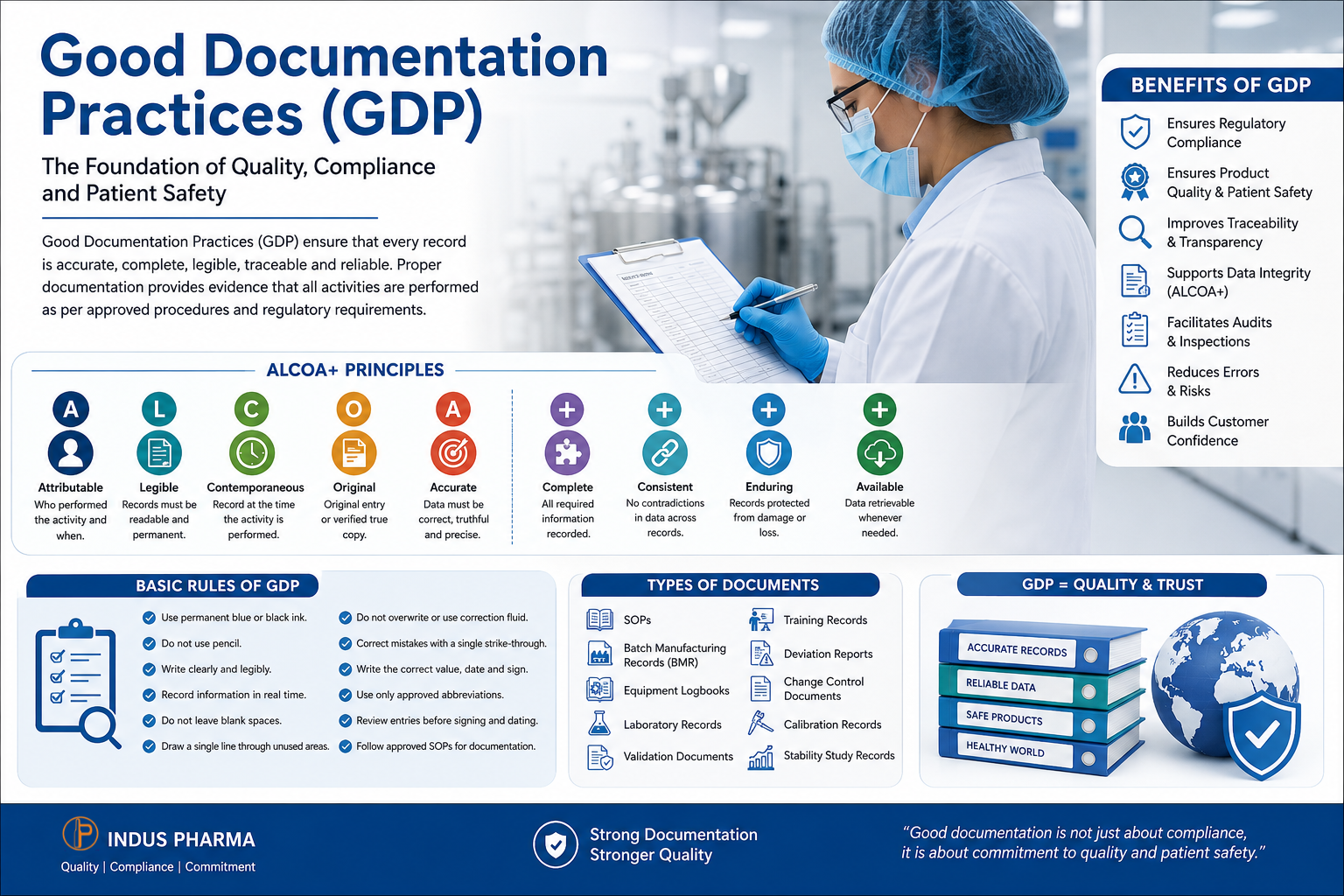
Good Documentation Practices are a set of internationally accepted guidelines that ensure all records are accurate, complete, legible, traceable, and reliable. Proper documentation provides evidence that every process has been carried out according to approved procedures and helps maintain compliance with WHO-GMP, US FDA, EU GMP, PIC/S, and other regulatory authorities.
What are Good Documentation Practices (GDP)?
Good Documentation Practices (GDP) are a collection of standards and procedures that govern the creation, completion, review, storage, retrieval, and archival of documents and records throughout a pharmaceutical product's lifecycle.
The primary objective of GDP is to ensure that every recorded piece of information is:
- Accurate
- Complete
- Consistent
- Legible
- Timely
- Traceable
- Secure
Documentation provides proof that quality-related activities were performed correctly and according to approved procedures.
Why is GDP Important?
Effective documentation helps pharmaceutical organizations to:
- Ensure product quality and patient safety
- Maintain compliance with WHO-GMP and regulatory requirements
- Improve process consistency
- Enable traceability throughout manufacturing
- Simplify audits and inspections
- Reduce human errors
- Support investigations and root cause analysis
- Protect data integrity
Without proper documentation, even a correctly manufactured product may be considered non-compliant.
Types of Documents in Pharmaceutical Manufacturing
GDP applies to many different types of documents, including:
- Standard Operating Procedures (SOPs)
- Batch Manufacturing Records (BMR)
- Batch Packaging Records (BPR)
- Equipment Logbooks
- Calibration Records
- Cleaning Records
- Laboratory Test Records
- Stability Study Records
- Validation Documents
- Training Records
- Deviation Reports
- Change Control Documents
- CAPA Records
- Environmental Monitoring Records
Each document serves as evidence that activities have been performed according to approved procedures.
ALCOA+ Principles of Good Documentation
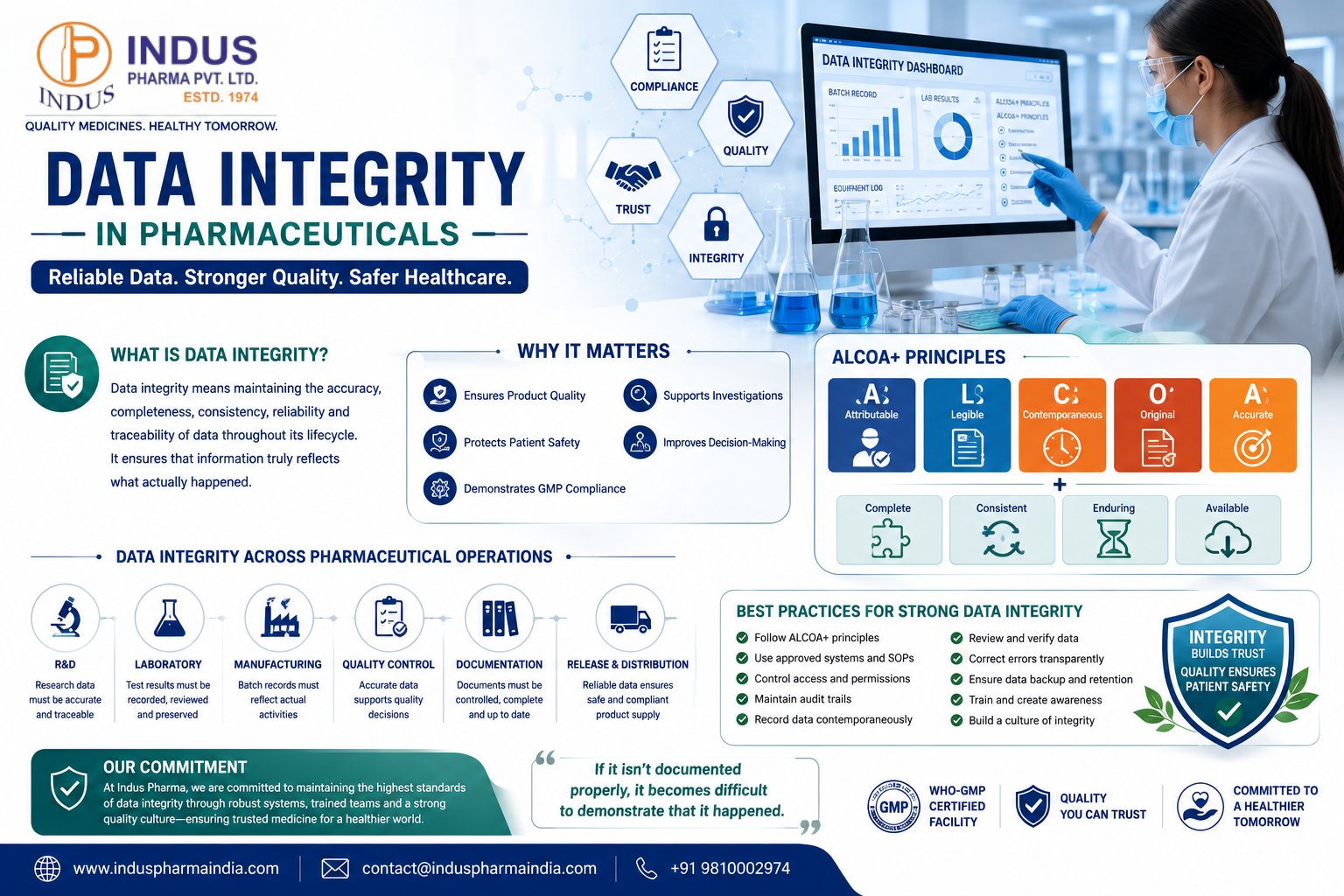
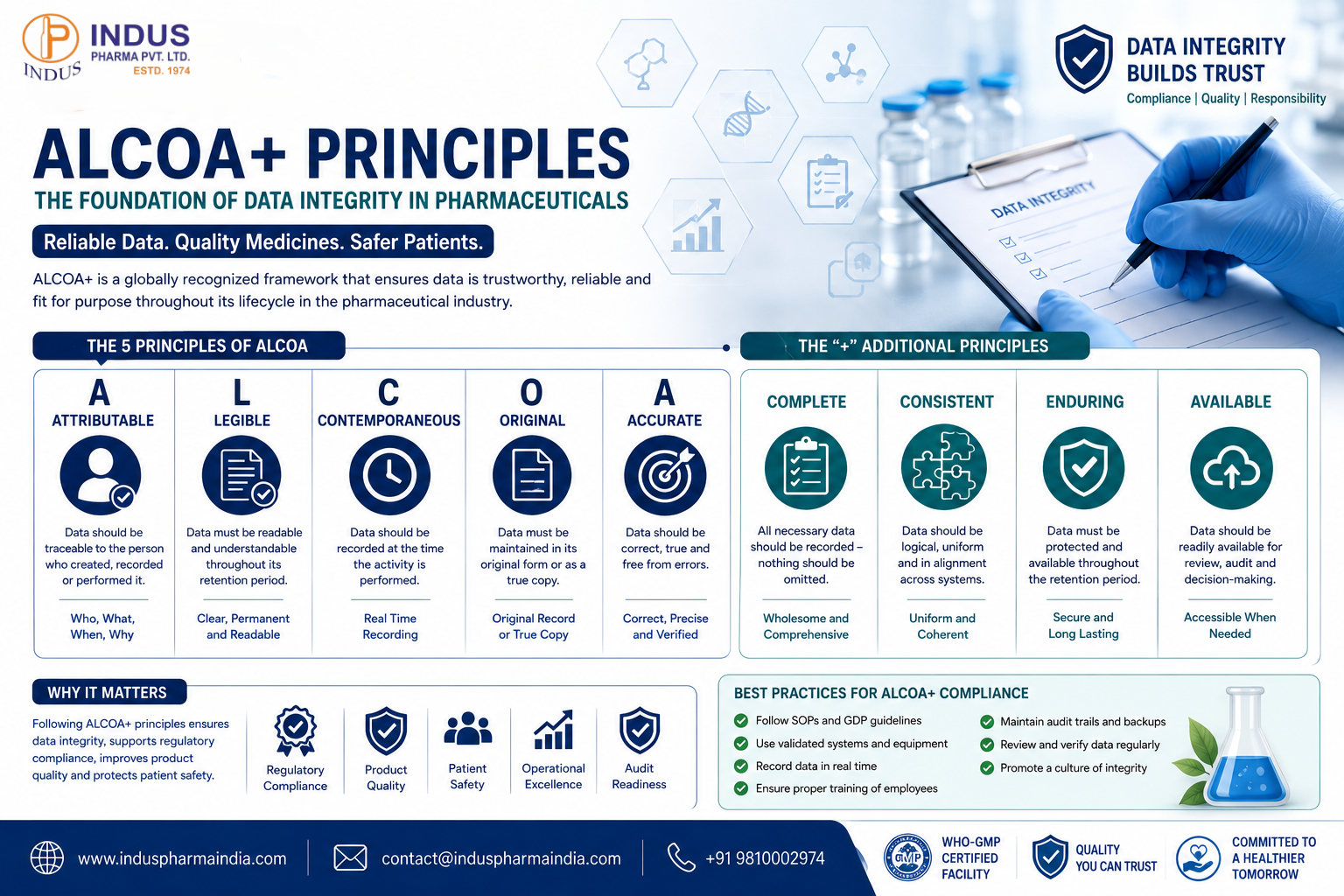
Modern pharmaceutical documentation follows the ALCOA+ Principles, which ensure data integrity.
A – Attributable
Every record should clearly identify:
- Who performed the activity
- Date
- Time
- Signature or electronic identification
L – Legible
Documentation should be:
- Easy to read
- Permanent
- Understandable
- Free from unclear handwriting
C – Contemporaneous
Information should be recorded at the time the activity is performed, not later.
O – Original
Records should represent the original observation or a verified true copy.
A – Accurate
Data must be:
- Correct
- Error-free
- Verified
- Truthful
Additional ALCOA+ Principles
Modern regulations further require documentation to be:
- Complete
- Consistent
- Enduring
- Available
Together, these principles ensure strong data integrity throughout the pharmaceutical manufacturing process.
Basic Rules of Good Documentation Practices
Employees should always follow these documentation rules:
Use permanent blue or black ink.
Never use pencil.
Write clearly and legibly.
Record information immediately after completing an activity.
Never leave blank spaces.
Draw a single line through unused fields.
Never overwrite existing entries.
Do not use correction fluid or erasers.
Correct mistakes using a single strike-through.
Write the correct value nearby.
Sign and date every correction.
Use only approved abbreviations.
Follow approved SOPs while documenting.
Common Documentation Errors
Some of the most common GDP violations include:
- Missing signatures
- Missing dates
- Backdated entries
- Blank spaces
- Illegible handwriting
- Incorrect calculations
- Missing page numbers
- Unauthorized corrections
- Use of correction fluid
- Recording data from memory instead of real time
- Missing batch details
- Incomplete equipment logbooks
These mistakes may lead to regulatory observations and product quality concerns.
Electronic Documentation and Data Integrity
Many pharmaceutical companies now use electronic systems such as:
- Electronic Batch Records (EBR)
- Laboratory Information Management Systems (LIMS)
- Document Management Systems (DMS)
- Manufacturing Execution Systems (MES)
- Enterprise Resource Planning (ERP)
Even electronic records must comply with GDP and data integrity principles by maintaining:
- Audit trails
- User authentication
- Controlled access
- Electronic signatures
- Backup procedures
- Version control
Benefits of Good Documentation Practices
Organizations that follow GDP experience numerous benefits:
Improved Regulatory Compliance
Supports inspections by WHO, US FDA, MHRA, EMA, and other regulatory agencies.
Better Product Quality
Ensures manufacturing activities are performed consistently.
Enhanced Traceability
Allows complete tracking of every batch from raw material to finished product.
Faster Investigations
Well-maintained records simplify deviation investigations and root cause analysis.
Reduced Human Errors
Standardized documentation minimizes mistakes and improves efficiency.
Increased Customer Confidence
Reliable documentation strengthens trust among healthcare professionals and international customers.
Best Practices for Employees
Every employee should:
- Read SOPs before performing tasks.
- Document activities in real time.
- Review entries before signing.
- Never guess values.
- Never sign for someone else.
- Report documentation errors immediately.
- Protect confidential documents.
- Maintain document version control.
- Participate in regular GDP training.
- Understand the importance of data integrity.
Regulatory Expectations
International regulatory agencies require pharmaceutical companies to maintain reliable documentation.
Key guidelines include:
- WHO Good Manufacturing Practices (WHO-GMP)
- EU GMP Annex 11
- US FDA 21 CFR Part 11
- PIC/S GMP Guide
- ICH Q7 and ICH Q10
- MHRA Data Integrity Guidance
Failure to comply with these requirements may result in regulatory observations, warning letters, product recalls, or suspension of manufacturing activities.
Conclusion
Good Documentation Practices are much more than paperwork—they are the backbone of pharmaceutical quality systems. Every document tells the story of how a product was manufactured, tested, and released for patient use.
By following GDP principles and maintaining accurate, complete, and traceable records, pharmaceutical organizations can ensure regulatory compliance, strengthen data integrity, improve operational efficiency, and most importantly, protect patient health.
At Indus Pharma, maintaining robust documentation practices is an essential part of our commitment to delivering safe, effective, and high-quality pharmaceutical products to healthcare professionals and patients around the world.
Frequently Asked Questions (FAQs)
1. What is GDP in pharmaceuticals?
GDP (Good Documentation Practices) refers to standardized guidelines for creating, maintaining, and controlling documents to ensure accuracy, traceability, and regulatory compliance.
2. Why are Good Documentation Practices important?
GDP ensures product quality, supports regulatory compliance, protects data integrity, and provides evidence that manufacturing activities were performed correctly.
3. What does ALCOA stand for?
ALCOA stands for Attributable, Legible, Contemporaneous, Original, and Accurate. The enhanced ALCOA+ principles also include Complete, Consistent, Enduring, and Available.
4. Can mistakes be erased from pharmaceutical records?
No. Errors should be corrected with a single strike-through, followed by the correct information, initials, date, and a reason if required by the SOP.
5. Which documents are covered under GDP?
GDP applies to SOPs, Batch Manufacturing Records, logbooks, laboratory records, validation documents, calibration records, training records, deviations, CAPA documents, and all quality-related records.