Ampoules and vials are two of the most widely used packaging formats for injectable medicines. While both are designed to maintain sterility and protect pharmaceutical products, they differ in design, usage, safety, storage, and clinical applications. This guide explains the differences between ampoules and vials, their advantages, disadvantages, and how manufacturers choose the right packaging for injectable products.
In the pharmaceutical industry, packaging is just as important as the medicine itself. Proper packaging protects injectable drugs from contamination, maintains sterility, extends shelf life, and ensures safe administration to patients.
Among the most common packaging formats for injectable medicines are ampoules and vials. Both are widely used in hospitals, clinics, pharmacies, and healthcare facilities, but each has unique characteristics and advantages depending on the type of medication and its intended use.
Understanding the differences between ampoules and vials helps healthcare professionals, pharmaceutical buyers, and manufacturers choose the most suitable packaging solution.
What is an Ampoule?
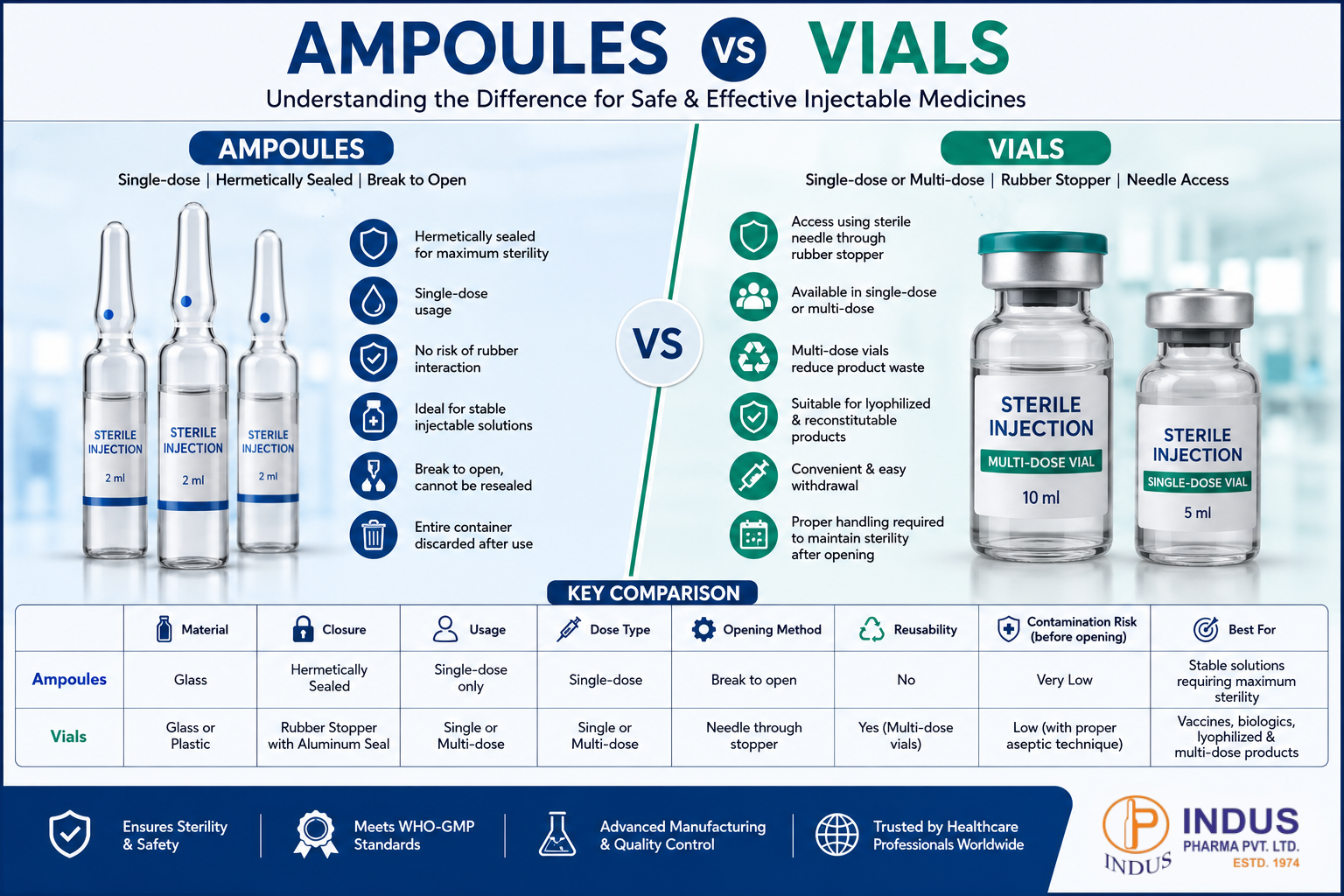
An ampoule (also spelled ampule) is a small, sealed glass container designed to hold a single dose of sterile medication.
The neck of the ampoule is melted and sealed during manufacturing, creating a completely airtight environment. Before use, the healthcare professional snaps off the top to access the medicine.
Because ampoules are permanently sealed, they provide excellent protection against contamination until opened.
What is a Vial?
A vial is a small bottle made from glass or high-quality pharmaceutical plastic, sealed with a rubber stopper and protected by an aluminum cap.
Unlike ampoules, vials can be accessed using a sterile needle through the rubber stopper. Depending on the product, a vial may contain a single dose or multiple doses.
Vials are commonly used for injectable medicines, vaccines, biologics, antibiotics, and lyophilized (freeze-dried) products.
Ampoules vs Vials: Key Differences
| Feature | Ampoules | Vials |
|---|---|---|
| Material | Glass | Glass or Plastic |
| Closure | Hermetically sealed | Rubber stopper with aluminum seal |
| Usage | Single-dose | Single-dose or Multi-dose |
| Reusability | Cannot be resealed | Can be accessed multiple times (multi-dose) |
| Risk of Contamination | Very Low before opening | Low when proper aseptic technique is followed |
| Opening Method | Snap open | Needle through rubber stopper |
| Shelf Life | Excellent due to airtight seal | Excellent when properly sealed |
| Waste | Entire container discarded | Multi-dose vials reduce waste |
| Common Applications | Small volume injectables | Vaccines, biologics, antibiotics, injectables |
Advantages of Ampoules
Ampoules remain one of the most trusted packaging options for sterile injectable medicines.
Excellent Sterility
Because the container is completely sealed, there is minimal risk of microbial contamination before opening.
No Rubber Interaction
Since ampoules do not use rubber stoppers, there is no possibility of interaction between the drug and closure material.
Ideal for Single-Dose Medicines
Each ampoule contains one accurately measured dose, reducing medication errors.
Longer Product Stability
The airtight seal protects sensitive medicines from moisture, oxygen, and environmental contaminants.
Limitations of Ampoules
Despite their advantages, ampoules have some limitations.
- Glass can break during handling.
- Opening requires care to avoid injuries.
- Glass particles may be generated when snapped open.
- Cannot be resealed after opening.
- Entire contents should be used immediately.
Advantages of Vials
Vials offer flexibility and convenience, making them one of the most widely used pharmaceutical packaging formats.
Multi-Dose Capability
Some vials allow multiple doses to be withdrawn while maintaining sterility.
Easy Handling
Healthcare professionals can access medicines quickly using sterile syringes.
Suitable for Freeze-Dried Products
Many biologics and vaccines are supplied in lyophilized form inside vials.
Reduced Product Waste
Multi-dose packaging can lower medicine wastage in hospitals and vaccination programs.
Better for High-Value Medicines
Expensive injectable medicines are often packaged in vials to maximize utilization.
Limitations of Vials
Although highly versatile, vials require strict aseptic handling.
Potential challenges include:
- Risk of contamination after first puncture.
- Rubber stopper compatibility must be evaluated.
- Multi-dose vials require preservatives in some formulations.
- Improper handling may shorten product life after opening.
Single-Dose vs Multi-Dose Vials
Single-Dose Vials
Designed for one patient and one administration only.
Examples include:
- Antibiotic injections
- Emergency medicines
- Oncology drugs
Multi-Dose Vials
Contain multiple doses and may include preservatives to prevent microbial growth after repeated access.
Examples include:
- Insulin
- Vaccines
- Anesthetics
- Hormonal injections
Manufacturing Considerations
Selecting between ampoules and vials depends on several factors.
Manufacturers evaluate:
- Product sensitivity
- Required shelf life
- Sterility requirements
- Filling process
- Packaging cost
- Export regulations
- Hospital requirements
- Regulatory guidelines
For highly sensitive injectable formulations, packaging selection plays a critical role in maintaining product quality throughout its lifecycle.
Quality Standards for Ampoules and Vials
Pharmaceutical packaging must comply with stringent international quality standards.
These include:
- WHO-GMP Guidelines
- Good Manufacturing Practices (GMP)
- ISO Standards
- Sterility Assurance Requirements
- Container Closure Integrity Testing (CCIT)
- Pharmacopoeial Standards (USP, EP, IP)
Manufacturers also perform rigorous quality checks such as:
- Visual inspection
- Leak testing
- Sterility testing
- Particulate matter testing
- Dimensional verification
- Container integrity testing
Which Packaging is Better?
There is no universal answer, as the choice depends on the product and its intended use.
Choose Ampoules When:
- A completely sealed sterile environment is required.
- The medicine is intended for single use.
- Long-term stability is a priority.
- No preservatives should be used.
Choose Vials When:
- Multiple doses are required.
- Reconstitution before use is necessary.
- The medicine is expensive and wastage should be minimized.
- Flexible dosing is needed in hospitals and healthcare facilities.
Applications in the Pharmaceutical Industry
Ampoules and vials are widely used for manufacturing:
- Antibiotic Injections
- Vitamin Injections
- Analgesics
- Vaccines
- Hormonal Preparations
- Oncology Medicines
- Cardiovascular Drugs
- Emergency Medicines
- Intravenous Solutions
- Biological Products
Future Trends in Injectable Packaging
The pharmaceutical packaging industry continues to evolve with new technologies that improve patient safety and product quality.
Emerging trends include:
- Ready-to-use sterile packaging
- Prefilled syringes
- Advanced container closure systems
- Smart packaging with traceability
- Improved glass formulations
- Sustainable packaging materials
- Automated visual inspection systems
These innovations are helping manufacturers enhance efficiency while meeting global regulatory expectations.
Frequently Asked Questions (FAQs)
Which is safer, an ampoule or a vial?
Both are safe when manufactured and handled according to GMP standards. Ampoules provide a fully sealed environment before opening, while vials offer convenience and flexibility for single- or multi-dose use.
Why are ampoules made of glass?
Glass is chemically inert and provides excellent protection against moisture, oxygen, and contamination, making it ideal for many injectable medicines.
Can vials be used multiple times?
Single-dose vials are intended for one use only. Multi-dose vials can be accessed multiple times using proper aseptic techniques and within the recommended period after opening.
Which packaging is commonly used for vaccines?
Many vaccines are supplied in vials because they may require multi-dose administration or reconstitution before use.
Are ampoules better for injectable medicines?
Ampoules are ideal for single-dose sterile products requiring maximum protection, while vials are preferred when flexibility, reconstitution, or multi-dose use is needed.
Conclusion
Ampoules and vials are both essential components of modern pharmaceutical packaging, each offering distinct advantages for sterile injectable medicines. Ampoules provide superior protection through a hermetically sealed design, making them ideal for single-dose formulations, while vials offer flexibility for single- and multi-dose applications, biologics, and products requiring reconstitution. The choice between the two depends on factors such as product stability, dosage requirements, regulatory compliance, and clinical use. By selecting the appropriate packaging and adhering to international quality standards such as WHO-GMP, pharmaceutical manufacturers can ensure the safety, efficacy, and reliability of injectable medicines delivered to patients worldwide.